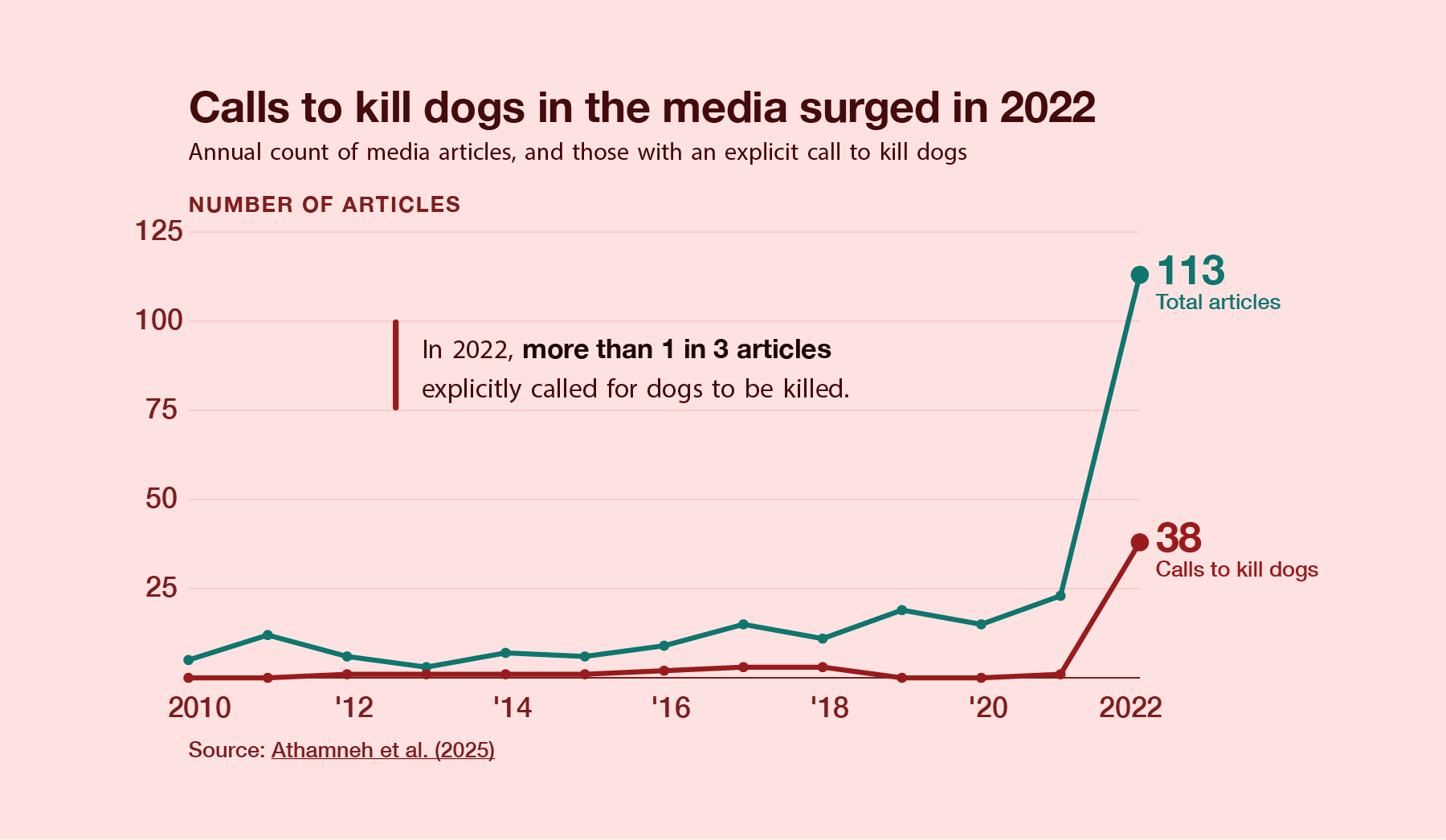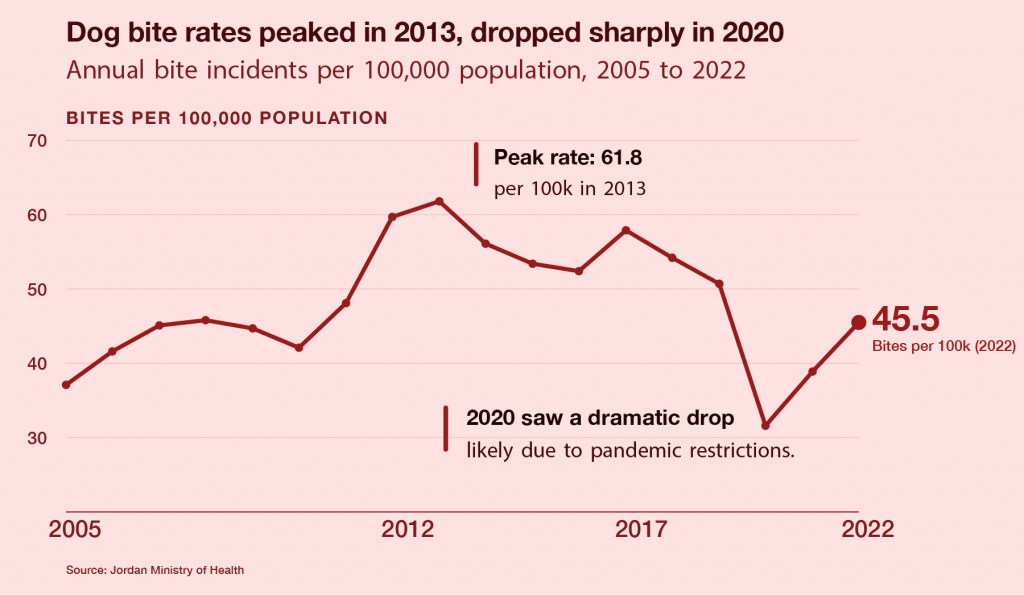
If stray dogs posed a rapidly growing threat to public safety, we would expect to see it in the Ministry of Health data. We don’t.
For our study, we reviewed the MOH Annual Statistical Books from 2005 onward — the only systematic public-health data relevant to the stray dog question in Jordan. Two findings stand out.
Human rabies is rare. Between 2005 and 2021 — eighteen years — Jordan recorded a total of eleven cases of human rabies. Rabies is a serious zoonotic disease that deserves continued vigilance, and there are legitimate concerns about under-reporting and the lack of a wildlife-vaccination policy. But the scale of reported cases does not support the idea of a public-health emergency. Separately, the share of dogs among all confirmed rabid animals has been trending downward since 2005.
Bite incidence is declining. The MOH reports thousands of animal-inflicted injuries annually — figures commonly referenced in the media as “dog bites” and cited to illustrate the severity of the stray dog problem. In reality, these totals combine injuries inflicted by dogs, cows, donkeys, and other mammals. The absolute numbers are real, and individual injuries can be severe. But when converted to an incidence rate (bites per 100,000 population), the rate has decreased significantly over the last decade. Jordan’s ten-year average is 42.1 bites per 100,000.
That figure is striking in international context. Chile reports about 240 per 100,000. Three Bhutanese cities reported between 285 and 879. India’s Punjab province reports around 896. Rural Cambodia has recorded as many as 5,000. Jordan’s rate is a small fraction of what countries with comparable or more serious stray-dog challenges report.
To be clear: bites matter. Every injured child matters. The point is not that the problem is trivial — the point is that the data do not support the specific claim that drove the 2022 outrage, namely that the stray-dog threat is rapidly growing. A serious policy response has to start from what is actually happening, not from what is circulating virally.
This is the argument for a One Health approach: one that takes human safety, animal welfare, and the underlying data equally seriously, and treats them as parts of the same problem rather than opposing concerns.