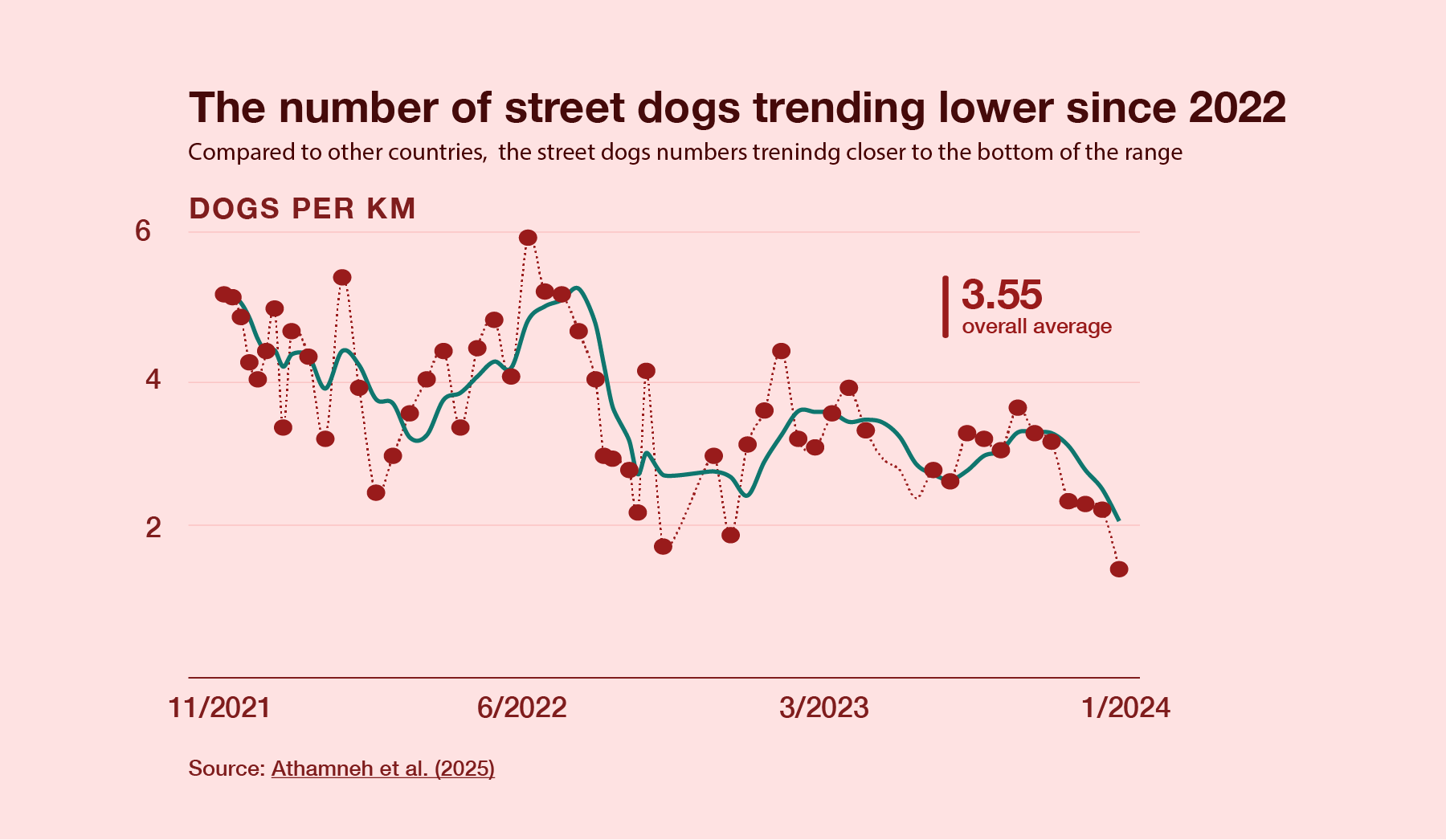
Our published study answered one set of questions — how many dogs in Irbid, where they are, and how those numbers have changed over time. It highlights another set we have not answered yet: how do Jordanians actually feel about stray dogs?
Public policy on this issue runs on public sentiment. In Jordan, hostility toward dogs is culturally entrenched and was sharply amplified in 2022 by a media cycle whose effects are still with us. But in the absence of a properly designed survey, we don’t really know where the broader public stands. Our observations — and the media analysis in our paper — may be capturing the loudest voices rather than the full population.
Al-Yarmouk aims to establish that baseline. The goal is to develop a standard instrument for tracking public attitudes over time, so that future awareness campaigns can be evaluated against evidence rather than intuition. Combined with our ongoing population counts, the two data streams will give Jordan something it has never had: a measurable picture of both the animals and the attitudes.
This is where partners and donors come in.
We are actively looking for research collaborators. Universities, veterinarians, public-health researchers, NGOs, and journalists — if your questions overlap with ours, we would like to talk. Co-authored studies, shared instruments, expansion of the survey to other Jordanian cities, and joint grant applications are all on the table.
More than money, we need expertise. Al-Yarmouk is not starting from zero. Our teams at the VET9 Small Animal Hospital and the Sanctuary already bring substantial human and physical resources to the table — clinical staff, field operations, animal-care infrastructure, and direct contact with the communities we serve. What we need most is partners willing to contribute knowledge and time: researchers, statisticians, survey methodologists, and practitioners who can help us turn that operational capacity into rigorous, publishable science.
Funding still matters. Expanding the survey, running a national attitudes questionnaire, and publishing additional peer-reviewed findings all cost money that we raise case by case. Every contribution — large or small — goes directly into field data collection, survey design, statistical analysis, and open-access publication so that findings reach decision-makers.
If Jordan is going to move from manufactured panic to evidence-based policy, this is the kind of work that has to be done. We would be grateful for your support.