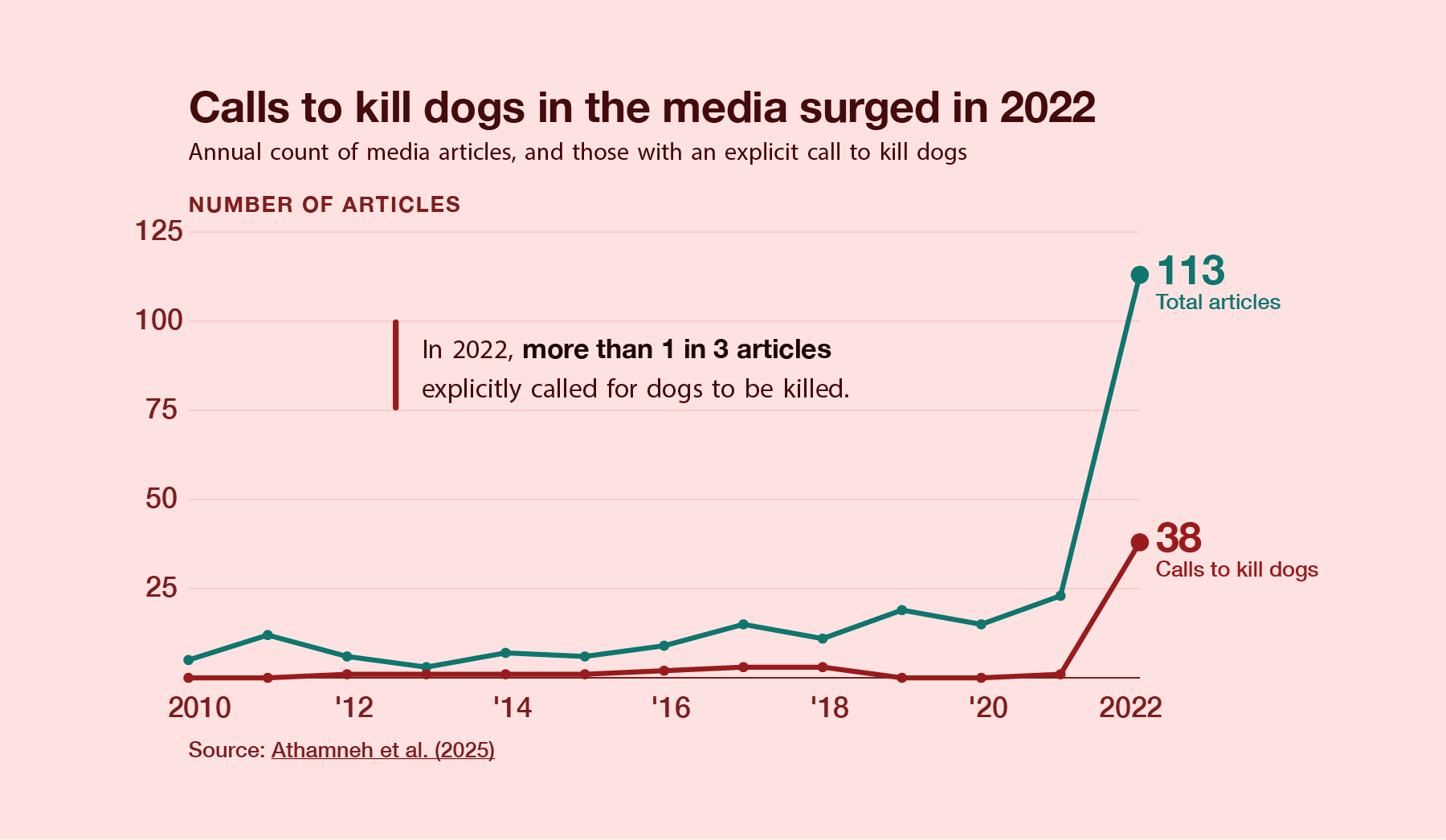
If you follow Jordanian media, you might conclude the country is in the middle of a stray dog emergency. Headlines warn of out-of-control populations. Public officials cite figures like 100,000 to 200,000 dogs in cities that, on systematic measurement, have a fraction of that number.
Let’s be clear: stray dogs are a real public health concern in Jordan. Bites happen. They can be serious. Rabies remains a credible zoonotic risk. People are right to expect public safety, and any honest welfare organization has to engage those concerns rather than wave them away.
But the data show something specific:
The problem is not growing. By most measurable indicators, it is shrinking.
Our published 2025 study found dog density in Irbid is low by international standards — comparable to Bosnia or Bali, well below Kathmandu, Quito, or Goa. The trend over our two-year measurement window is downward. Reported dog-bite incidence in Jordan is declining over the past decade. Jordan’s bite rate is a small fraction of what countries with serious stray dog problems actually report.
So the picture the data describe is: a real public health issue, of modest scale by international comparison, trending in the right direction.
The picture the media describes is: a runaway crisis, escalating daily, requiring severe intervention.
Both pictures cannot be true. And the gap matters, because policy is shaped by perception. When the perceived problem is “200,000 uncontrolled dogs growing daily,” the policies debated are extreme — culling, mass poisoning, indiscriminate removal. When the actual problem is “a manageable population trending down, where targeted humane intervention can succeed,” the available options are very different.
Closing this gap is not about dismissing public concern. It is about giving the conversation a shared factual foundation. This is why we publish, why our methods are open, and why our street dog surveys year after year matter more than any single headline.
A note of intellectual honesty: our position is tentative and subject to change with new evidence. If sound data later show the situation is materially worse than current measurements indicate, we will say so. That is what evidence-based work requires.