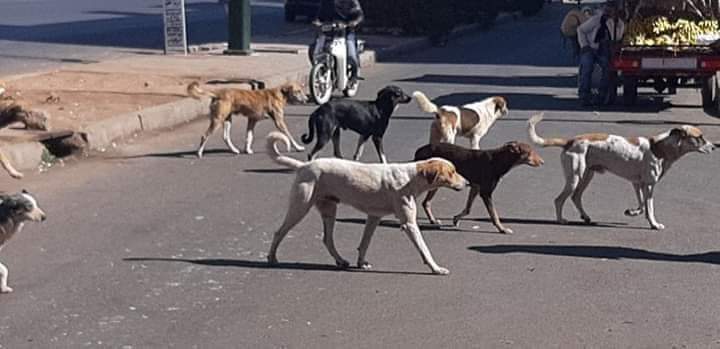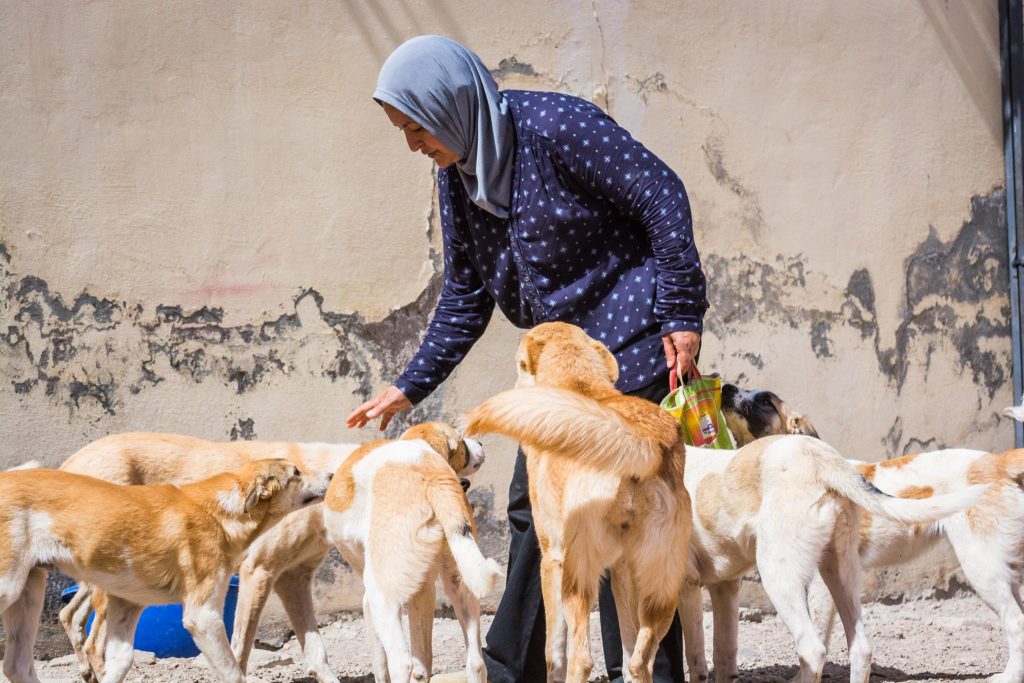
Where do Jordan’s street dogs come from?
The intuitive answer — and the one most population-control programs implicitly assume — is that street dogs reproduce on the street, and that sterilizing visible street dogs will, over time, shrink the population. That assumption is the foundation of conventional trap-neuter-return (TNR) programs worldwide.
Our years of observation in Jordan suggest the assumption does not hold here.
Survival on the street is brutal. Adult street dogs in Jordan face shooting, poisoning, vehicle collisions, malnutrition, and uncontrolled outbreaks of parvovirus and other lethal diseases that go largely unmonitored by any veterinary surveillance system. Life expectancy is short. We have repeatedly observed female dogs giving birth to large litters on the street and losing every puppy within weeks.
If street dogs were reproducing on the street at replacement rate, we would not see what we see. Yet the population persists. Where, then, is it being replenished?
The source is not visible — because it isn’t on the street. Across rural Jordan and on the edges of urban areas, farmers and sheep keepers commonly maintain large numbers of unsterilized dogs around their property. Outdoor businesses — construction-material warehouses, workshops, brick and tile makers, scrap yards — keep dogs for protection. These dogs are loosely owned: rarely fed consistently, almost never given veterinary care, almost never sterilized. But they receive enough — water, intermittent food, physical shelter — for their puppies to survive past the critical first weeks. A female dog living in this semi-protected status has a meaningfully higher life expectancy and reproductive output than one fully on the street.
When those puppies grow up, many are turned out. That is where street dogs come from.
This finding has a direct implication: a TNR program targeting visible street dogs is unlikely to reduce the overall population, because the population is not being produced where the program is operating. You can sterilize every street dog in Irbid and the population will be replenished from the source.
This is not an argument against sterilization. It is an argument for targeting. Spay/neuter remains a core welfare intervention — but in Jordan, the intervention has to reach the loosely-owned source population, not the visible street population. Al-Yarmouk’s free spay program for owned dogs is built around exactly this logic.
In our published 2025 study, the dog density along our Irbid route is already low by international standards and trending downward. The question for the next decade is not how to sterilize street dogs faster. It is how to reach the source — and that requires a different kind of program, designed for a different population.