Since November 2021, a team from Al-Yarmouk has driven the same 25-kilometer route through Irbid every two weeks, counting every stray dog we see. The route was designed to capture the city’s full mix of landscapes — dense urban neighborhoods, lower-density areas, and the open countryside on Irbid’s edges. The method follows a protocol developed by Hiby and Hiby (2017) and used in dog population studies around the world.
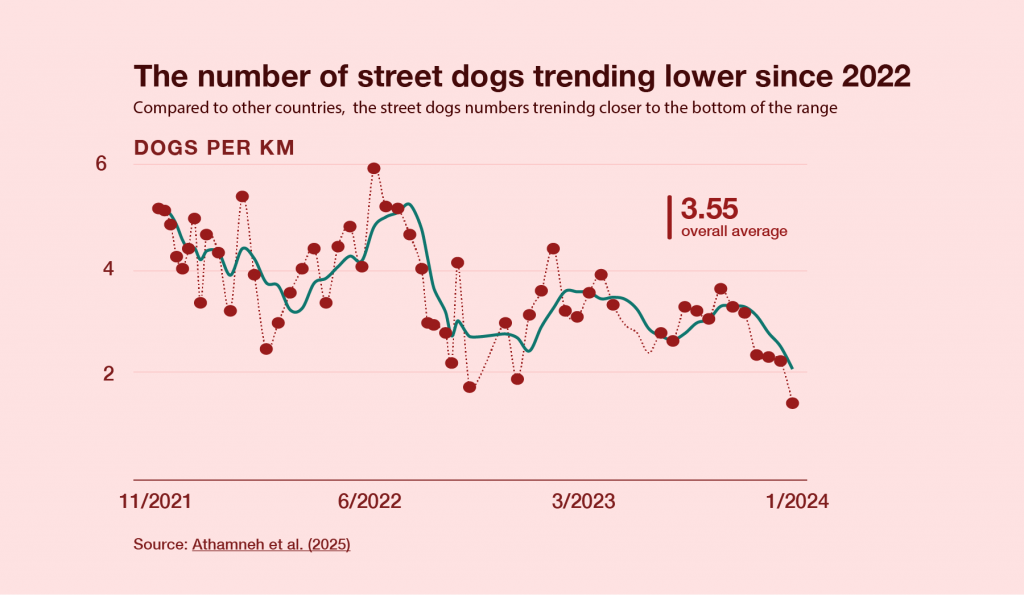
Between November 2021 and November 2023, we observed an average of 3.55 dogs per kilometer, with values ranging from 1.36 on our lowest days to 6.04 on our highest. In international context, that places Irbid toward the low end of reported densities — below Kathmandu (14.17), Quito (8.33 urban / 6.51 rural), Goa (6), and Romania’s Constanța county (5.66); in line with Bosnia (3.78) and Sanur, Bali (3.81).
The data also show a statistically significant decrease in the number of dogs along the route after September 2022 (Mann-Whitney U, p < 0.05), coinciding with the dramatic spike in hostile media coverage and the wave of violence against dogs that followed. Seasonality matters too: counts are significantly higher in summer, consistent with breeding cycles documented elsewhere — an important consideration for the timing of any intervention.
One finding has particularly direct policy relevance. The mayor of Irbid has repeatedly cited estimates of 100,000 to 200,000 stray dogs in a city of 1.12 million people, arguing that fertility-control programs could never work at that scale. Applying our dogs-per-kilometer figure to the total length of Irbid’s streets produces a very different estimate: fewer than 5,000 dogs in the entire city.
That gap — between what is widely assumed and what can be measured — is exactly why this kind of research exists. A city with 5,000 stray dogs is a manageable policy problem. A city with 200,000 is a crisis that invites extreme measures. Getting the number right changes what solutions look realistic.
The count continues. Every biweekly data point strengthens the evidence base.