Public attitudes toward dogs in Jordan are not innate. They are learned — through household culture, religious framing often inherited without close examination, media, schoolyard reinforcement, and the absence of positive direct experience with animals.
Adults who are hostile to dogs today were children once. The most efficient way to change attitudes at population scale is to reach the next cohort while attitudes are still forming.
Attitude research consistently finds that early positive experiences with animals shape adult attitudes more than any other single factor. Lectures don’t do it. Campaigns don’t do it. Direct, structured, well-supervised contact does.
Where we are.
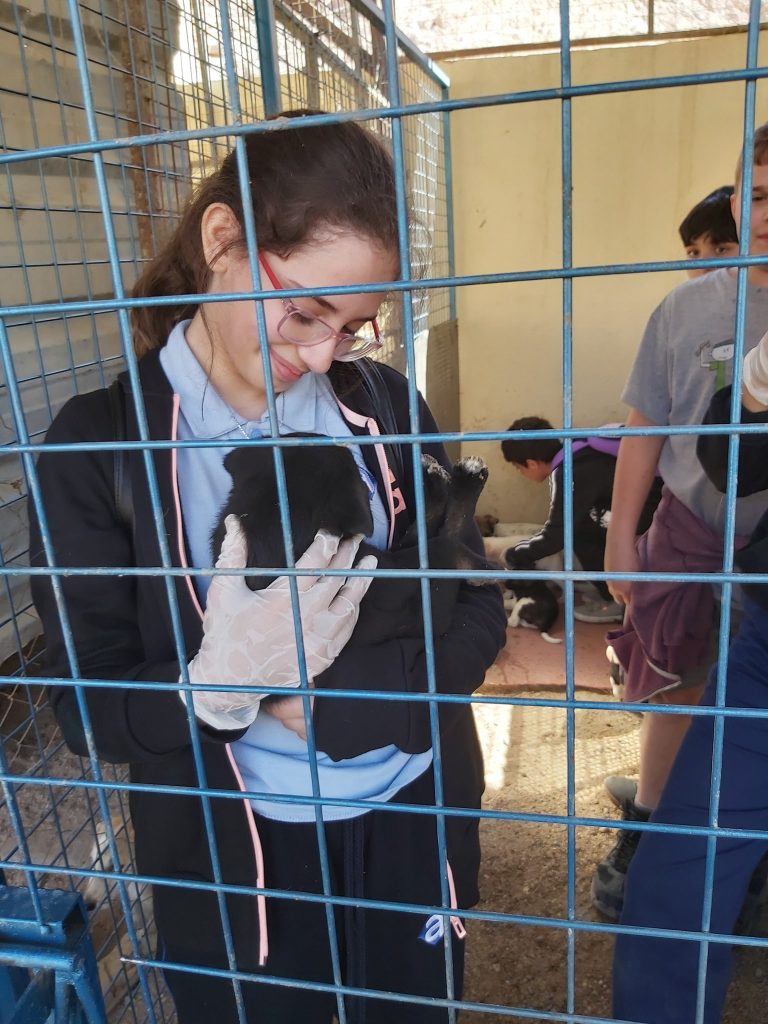
Al-Yarmouk has run school outreach activities — including organized visits between schoolchildren and the dogs at our partner shelters.These have been some of the most rewarding moments of our work, and a fraction of what’s needed.
Where we want to go.
Jordan has roughly two million children currently in school. Reaching them meaningfully requires program infrastructure we have not yet built: structured curriculum materials in Arabic, partnerships with school districts and the Ministry of Education, trained facilitators across multiple cities, and a research component to measure attitude change over time.
This is a multi-year program-development effort. We are at the beginning of it.
We need partners — and we are explicit about this.
Local partners. Schools, school districts, teachers, parent associations, Jordanian NGOs in education and youth development. If you teach, run a school, or have ties to the Ministry of Education, we want to hear from you.
International partners. Organizations with established humane education programs have decades of materials and expertise we are not going to recreate from scratch. We are open to adapting existing programs for the Jordanian context, jointly developing new materials, and longer-term collaboration on attitude-change research.
A child who plays with a friendly puppy at age eight is meaningfully less likely, at age thirty-five, to support culling. They are dramatically more likely, if they end up in a position of public influence, to make decisions aligned with humane policy — not because they were lectured into it, but because the underlying intuition was set decades earlier.
Today’s children will run the country. Our laser focus is on making sure that, when those decisions are theirs, they are made by adults who have actually known a dog.